The Indigo fiasco
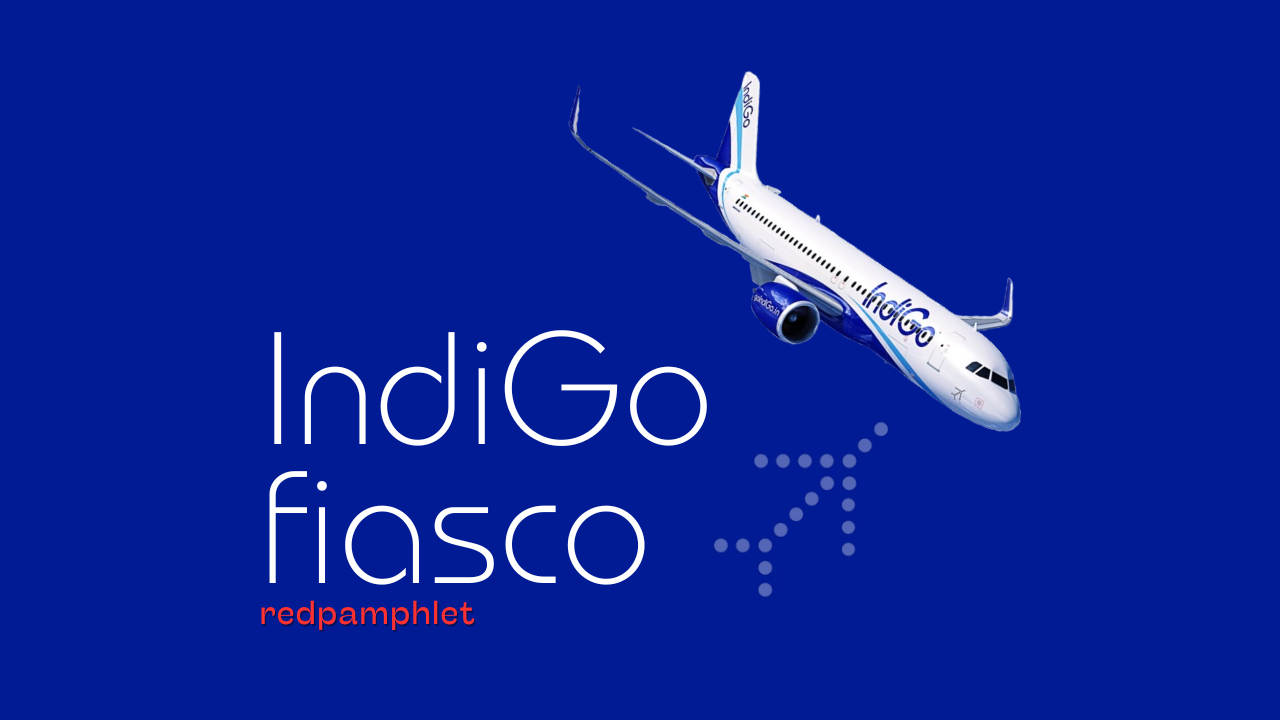
Last week, India witnessed the collapse of its air travel services; it's been 8 days and counting. We saw at airports, tens of thousands waiting in confusion; people missed medical appointments, interviews, exams, weddings and funerals, Well over 2,000 flights have been cancelled and several thousand more severely delayed so far, affecting more than 10 lakh passengers, all because a private corporation refused to adequately prepare for FDTL(Flight Duty Time Limit) rules notified months in advance (almost a year ago).
FDTL controls pilots' duty and flight time, initially meant to be implemented in June 2024, and they are supposed to ensure the safety of passengers. The new changes include:
- Increase in weekly rest for pilots from 36 to 48 hours continuously.
- Night shift redefined from 00:00-05:00 to 00:00-06:00.
- Now pilots can perform a maximum of two landings in any night duty (00:00-06:00), down from up to six previously.
- No more than two consecutive nights of duties are permitted before mandatory extended rest.
- Airlines will have to submit quarterly fatigue reports and arrange for rostering accordingly.
FDTL is a minimal legal recognition that labour power is not an infinite commodity but a living human capacity that must be reproduced through rest, health and social life. Capital experiences such limits as an obstacle to profit, and therefore resists or circumvents them whenever possible. As per the announcement by the government, these rules were supposed to be implemented in June 2024, but implementation was pushed to 2025 under industry pressure. First phase started in July 2025 to which Indigo was able to comply, Once full enforcement kicked in other airlines complied, IndiGo didn’t, still following its low cost, lean staffing model unable to implement new rules cancelled or delayed hundreds of flights in just a couple of days, till now about over 2,000 flights cancelled and several thousand more severely delayed so far, impacting more than 10 lakh passengers. The Federation of Indian Pilots pointed out that other airlines had adapted without major impact and that IndiGo's challenges stemmed from "years of lean manpower planning" and delayed hiring, non-poaching arrangements and other short-sighted planning practices.
For years, we saw Air India being left to crumble on its own to justify the need for its privatisation. Time and again, privatisation was touted as the and only path to salvage it. While all along we also saw privately owned carriers come and go, Sahara Airlines, Jet Airways, Kingfisher Airlines, and Go First were all grounded. Amongst all, IndiGo has been widely regarded as the most operationally efficient airline in the Indian market. It scaled up on the back of competitively priced flights and disciplined service. Surviving the period of free competition, it now holds a monopoly over Indian Air traffic. So much so that it is able to dictate the terms of the industry as we clearly see the way DGCA and the government is reacting to the whole situation.
This is the classic tendency of capital towards concentration and centralisation: weaker capitals are wiped out or absorbed, and one or two giants survive, now ‘too big to fail’. When they stumble, the state rushes to save them, not because they are efficient but because the entire network has been built around their dominance.
Like in every other such crisis (Pahalgam attack, disasters in Uttarakhand, Kumbh mela), all private airlines practised price gouging. After every such incident, we see how the commodification of essential services leads to complete ignorance of public good and a humane approach in order to pursue profits. This clearly justifies the need for a public carrier and demand of state owned industry in other sectors that deal with public service like transport, communication, education and healthcare.
IndiGo now controls about 65% of India’s domestic airline market with over 2,000–2,300 flights daily, it is the only operator on roughly 60% of domestic routes, and together with the Air India it accounts for over 90% of domestic passengers it is the sole operator on around 60.4% of India’s domestic routes, which is even sharper than “65% of passenger share, it holds the clear monopoly in the sector, considering its position it rightly hoped for relaxation from DGCA, obviously management would not have expected such disruption and could have avoided the fiasco comfortably but their goal is profit not compliance certificates.
This profit maximisation pushed to the point where the real conditions of labour (rest, safety, human limits) are systematically denied. The inherent nature of capitalist economy is to move towards monopolisation now two airlines carry more than 90 per cent of all domestic passengers. We saw how a monopoly in the sector turned a regulatory tweak into a crisis. We can see how other public sectors like telecom are prone to such crises due to monopolies.
This is not an accident but a structural feature: the company tried to maintain or increase profit rates by holding down the variable capital (wages, headcount) while stretching labour time to the legal and physical limit. The new FDTL rules simply drew a firmer legal boundary around what capital had already informally been violating; the crisis is the clash between labour’s finite capacity and capital’s unlimited demand for surplus labour. It speaks volumes on the demand for deregulation which capital makes in the name of 'Ease of Doing Business' leading to dismantling of protectionist laws for labour. The Labor Codes usher in such deregulation leading to serious consequences, whatever the form it may take.
The pilots’ federation explicitly accuses IndiGo of cartel like practices – non poaching pacts and pay freezes – which prevent competitive hiring and keep wages suppressed across the industry. The company followed lean staffing model, disregarded working hours which are detriment of safety, company showed callous disregard of lives for profit maximization, and we all know in case of any accident workers get the blame not the management which enforces policies worsening the working condition leading to the accident. IndiGo’s hiring freeze, non poaching arrangements and refusal to expand crew strength even as it added routes are concrete expressions of this drive to squeeze more unpaid labour time out of a shrinking workforce. Sole blame lies with the Incompetence of the administration and management, a private listed corporation having monopoly over the sector under-investing in resilience while supervisory body remained muted is a combined failure of governance and regulation while the frontline workers who are paid merely 16-20 thousands (as an open letter by Indigo Employee and many reports suggest) at IndiGo bore the brunt of decisions, faced angry crowds of passengers.. Yet in the end the corporate leadership and people within the ministry and DGCA will come out as heroes as if they saved the nation from further pain, brushing off that they didn’t do it right, the first time.
The workers unions and associations in the sector lack the strength and support to effectively raise the issues faced by workers. Behind the silence of many workers is the pressure of the reserve army of labour: pilots, crew and ground staff know that in an industry with repeated bankruptcies and few dominant employers, losing a job can mean exiting the labour market altogether or forced migration. This fear disciplines workers and allows capital to normalise fatigue, harassment and low pay.
During the crisis Indigo app and websites continued to display “on time” while airport boards recorded hours of delay. No SMS, WhatsApp message or in-app alert reached customers about flight delays. Passengers were not aware of the operational reality leading to financial loss through missed connections, extended accommodation costs and cancelled commitments. Communication during crisis failed completely while marketing campaigns by these companies reach customers even if it needs violating their privacy. All talk about Digital India, while the very foundation of the industry is on shaky grounds i.e compromise with passenger safety, services and over-exploitation of workers. But this digital opacity is not accidental; transparency during a crisis would trigger legal obligations for refunds and compensation, so the information was withheld.
We see here how in a capitalist economy how essential mobility is commodified, the ability of millions to work, study, care for relatives or even attend funerals depends on the uninterrupted functioning of a few profit seeking firms in ‘core’ infrastructure sectors.
Government’s approach to every crisis is via event management, news of setting up war/control rooms, videos of ministers and officials visiting terminals, railway stations after stampedes. A private corporation gambled with staffing, worker and passenger safety, collapsed, and the state is now rearranging rules to stabilise the market that it allowed to become so monopolised.
Earlier DGCA approved IndiGo’s expanded winter schedule without insisting on proof of adequate pilot strength for the new regime, despite its knowledge of lean staffing and pilot complaints and only after thousands were stranded and record cancellations happened did DGCA issue a strong show cause notice. All this even though pilot associations had clearly warned about IndiGo’s strategy and upcoming crisis due to the combination of FDTL tightening and IndiGo’s lean staffing, but no proactive audit or mandatory capacity check was imposed before winter schedules were approved. DGCA has now ordered a 5% cut in IndiGo’s winter schedule about 110 flights a day(out of total 2,200 domestic and international flights daily) and pledged to reallocate these slots, but this comes after the damage, not before that too since Indigo is not able to utilise them fully even when there was no crisis.
While the requirement was punitive action against IndiGo’s responsible management and full enforcement of the FDTL framework without carve-outs but instead of adjusting schedules to fit the rules, the country’s largest carrier has been granted selective rest dispensations that run counter to both the letter and intent of the regulations. As of now due to operational disruptions at IndiGo, DGCA granted temporary relaxations until 10 February 2026 allowing up to six night landings and reverting "night" to 00:00-05:00 for that airline.
This is classic “regulatory capture”: the state formally tightens rules but, when capital resists, it bends implementation in favour of the dominant one, while still allowing it to externalise the cost of its misplanning onto workers and passengers. It represents the natural tendency of capitalism that is concentration and centralisation of capital in the hands of one or few large capitals within a “core infrastructure” sector, a few large capitals dominate and the state becomes responsible for “managing” their crises, because any serious punishment to them threatens the functioning of the entire social reproduction process (movement of labour, goods, and capital). The present chaos shows how far this has progressed: grounding a substantial part of IndiGo’s fleet would paralyse a large chunk of national air travel, so the state is constrained to rescue the very capital that produced the problem. We see how the state is not acting as a neutral umpire, but rather as the ‘ideal collective capitalist’, rewriting safety norms and timetables to safeguard the continuity of maximum profits for a dominant private firm.
Union Civil Aviation Minister K Ram Mohan Naidu is now warning of exemplary action against the airline. Calling the fiasco an internal issue of Indigo is just shrugging off responsibility for the implementation of the regulation. When the crisis exploded, the swift response of the regulator was not to enforce strict compensation and structural corrections, but to dilute crew rest protections and manage public anger while keeping IndiGo operational.
This is what Lenin analysed under monopoly capitalism: the state becomes the ‘committee’ for managing the common affairs of big capital. In this crisis, thousands of workers and passengers paid the price so that a single dominant private airline could first maximise profits through understaffing and then be rescued when its strategy collapsed. The lesson is not that ‘the market failed once’, but that essential industries like transport (education, healthcare, communication, food production) cannot be left to profit logic at all.
A genuinely public system would be run on the principle of social need, with democratic worker and passenger oversight, not as a playground for private shareholders cushioned by state guarantees.

Redpamphlet